Studieprojekter
Projekter fra studietiden på Aalborg Universitet.
10. semester: Developing a Test Bed for AAUSat-II
Designing robust and fault tolerant systems is a difficult task. The possibilities of making errors are present both in hardware and software. Experience has shown that 50% of a software developer's working time is spent on testing and debugging, whereas less than 5% of the educational time is dedicated to these tasks. [Beizer, 1990]
When a satellite is launched into orbit, several man hours of development have been put into the construction of the satellite. To obtain a high possibility of a successful mission, the satellite should have undergone a severe amount of testing prior to the launch. Since the time available for testing student projects is often very reduced, a tool to help the integration testing is desirable.
On the previous CubeSat [CubeSat, 2003] satellite project the integration and testing was very difficult, because no specifications on how to perform these tasks were present. The test bed should include a set of minimum tests, so that some minimum extent of integration testing can be performed with little effort required from the subsystem developers.
Purpose: The purpose of this project is to develop a test bed for the AAUSat satellite system, and future pico satellites based on the same platform.
Group members: Morten Koch, Jesper Noer, Michael Pedersen
Language: English
9. semester: Developing a Robust Protocol for Wireless Fire Alarms
This project deals with the development of a communication protocol used to ensure a robust and reliable communication in a wireless fire alarm system.
Based on an analysis of the scenario consisting of wireless detectors communicating with gateways which are connected to a central unit via a cabled network, the communication technologies are chosen. The ZigBee protocol is chosen as the wireless communication standard, and the cabled network is simulated using RS232 connections.
An application layer protocol is developed on top of the ZigBee protocol, with high availability, reliability, robustness, and low power consumption as primary objectives.
A detector is designed and implemented using a TI-430F149 microcontroller and a gateway and central unit are merged and implemented on a Linux PC. Two Adcon Addlink 868 MHz ZigBee based radio modems are used as wireless links.
The designed protocol is verified using Uppaal to ensure that no live- or deadlocks exist, and the required specifications dictated by EN/DS standards are met.
The protocol software is implemented on a system consisting of one detector and one gateway/central unit.
Through testing it became evident that the developed protocol can provide robust and reliable communication between detector and central unit, with an error rate of less than 10-9 errors/hour.
Group members: Morten Koch, Jesper Noer, Michael Pedersen
Language: English
8. semester: Modelling and Simulation Platform for Large-Scale Network Structures
This report documents the development of a simulation platform for large-scale network structures. The platform is developed by using the object oriented language C++ with a command prompt user interface.
The platform can generate networks of different topologies. These are: simple ring, double ring, wheel, fully connected, N2Rpq and random topology. It is also possible to create a network manually. After generation the networks can be manipulated. The platform is able to simulate the maximum flow, number of hops and traffic load for networks up to 1500 nodes. The maximum simulation time for each of the algorithms is below 15 minutes.
A Java application presents the simulation results graphically in order to make it easy to compare network performance.
Group members: Frode Fjermestad, Peder Helle, Christian Lodberg, Michael Pedersen, Muhammad Tahir Riaz
Language: English
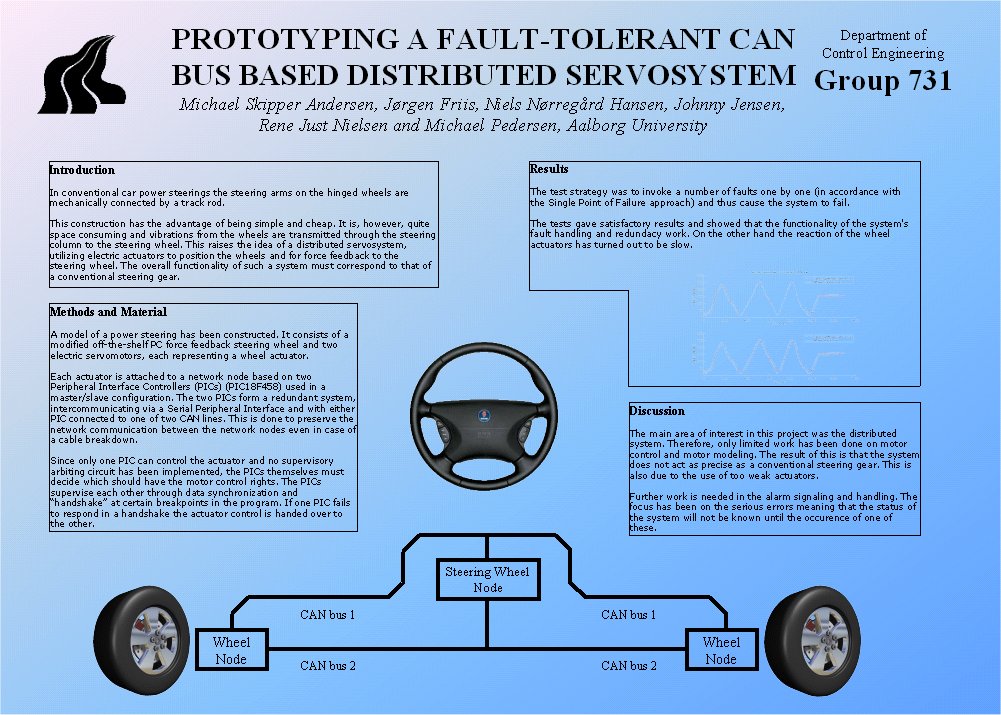
7. semester: Prototyping a Fault-tolerant CAN Bus Based Distributed Servosystem
In conventional car power steerings the steering arms on the hinged wheels are mechanically connected by a track rod. When the steering wheel is turned the rotation from the steering column, assisted by a hydraulic servo-cylinder, moves the track rod sideways, turning both wheels.
This construction has the advantage of being simple and cheap. It is, however, quite space consuming and vibrations from the wheels are transmitted through the steering column to the steering wheel. This raises the idea of a distributed servosystem, utilizing electric actuators to position the wheels and for force feedback to the steering wheel. The objective of this paper is to present and review the prototype of a duplicated Controller Area Network (CAN) bus based fault-tolerant distributed power steering, especially considering the pitfalls of such a system.
A prototype of a distributed servosystem has been tested with different scenarios and fault cases. The node connections and fault tolerance work satisfactorily and act as expected, but the actuators have proven to be underdimensioned.
Group members: Michael Skipper Andersen, Jørgen Friis, Niels Nørregård Hansen, Johnny Jensen, Rene Just Nielsen, Michael Pedersen
Language: English
6. semester: Design of a Controller for a Wind Tunnel
This project deals with the construction of a controller for the wind tunnel situated at the Institute of Energy Technology, Aalborg University.
This report documents a theoretical analysis and modeling of the physical wind tunnel together with an experimental modeling of the actuator of the tunnel, consisting of an AC motor with a fan mounted on the shaft and a frequency converter. Then it deals with the design of three controllers: a PID, a PID with an input filter and a state-space controller. With the use of a performance index and the controller features, the best suited controller for the tunnel is chosen. Further, the report documents the design of a graphical user interface for Windows 2000 that is the interface between the user and the control system. The interface is written in C.
The project has resulted in the control software pelecan together with a PID controller implemented in the wind tunnel control system.
Due to a very late instrumentation of the tunnel, it has not been possible to make a model verification. Therefore the controller designs are based on the unverified models, for which reason the controllers have been coarsely adjusted to be usable in the tunnel system.
Group members: Michael Skipper Andersen, Jørgen Friis, Niels Nørregård Hansen, Johnny Jensen, Rene Just Nielsen, Michael Pedersen
Language: English
5. semester: Satellitstrømforsyning
Denne rapport omhandler gruppe E5-510's projektarbejde omkring dimensionering af en strømforsyning til AAU Cubesat. Rapporten bygger på de krav, der er fastsat til AAU Cubesat. I projektet er hovedvægten lagt på at dimensionere en switchmode-strømforsyning med optimal nyttevirkning med tilhørende regulering.
Strømforsyningen er opbygget med en reguleret bus på 5 V og forberedt til at benytte solceller som input. Der er blevet udformet modeller til beskrivelse og dimensionering af konverterne. Der er realiseret tre konvertere, der fungerer i åben sløjfe, med nyttevirkninger på omkring 90%. Ligeledes er der opstillet modeller for reguleringen, som er opsplittet i en digital og en analog del. Den digitale realisering er udarbejdet teoretisk og forsøgt implementeret i en PIC16F877. I reguleringen er Maximum Power Point Tracking indeholdt for at opnå optimal udnyttelse af solcellerne. Den analoge regulering er beskrevet, men ikke realiseret i strømforsyningen.
Gruppemedlemmer: Jørgen Friis, Mikkel Borch-Jensen, Johnny Jensen, Søren Skak Jensen, Peter Kjeldmann, Michael Pedersen, Steffen Præstholm
Sprog: Dansk
4. semester: Styring af el-cykel
Gruppemedlemmer: Jørgen Friis, Mikkel Borch-Jensen, Johnny Jensen, Søren Skak Jensen, Michael Pedersen, Troels Pedersen, Steffen Præstholm
Sprog: Dansk
3. semester: Hi-Fi-forstærker
2. semester: Lineær strømforsyning – modellering og fremstilling
Gruppemedlemmer: Sune Holm Christensen, Johnny Jensen, Lars Dissing Overballe, Michael Pedersen, Steffen Præstholm, Kenneth Wosylus
Projektrapport: PDF
Sprog: Dansk
1. semester: Introduktion til neurale netværk
Gruppemedlemmer: Mads Fogh, Johnny Jensen, Bjørn H. Madsen, Lars Dissing Overballe, Michael Pedersen, Steffen Præstholm, Kenneth Wosylus
Sprog: Dansk